Easy to use and store.
"Easy to use and store. Works like a charm."
Orders placed M-F before noon CT ship same day


SKU:SOL-101
8oz jar
Made in USA
Couldn't load pickup availability
Silver Prep is an all natural 100% non-toxic food-grade pickle mix that is used to dissolve surface oxidation and flux residue from a metal's surface. It can be used as a traditional pickle for fine silver, sterling silver, copper and gold. Silver Prep is used to depletion gild sterling silver to fire directly in metal clay or to fuse metal clay directly to sterling silver during firing. This formula is non-harsh and easy-to-use
Silver Prep allows you to fire sterling silver directly with precious metal clay. You can apply metal clay to sterling silver or embed sterling silver into metal clay and fire together in the kiln or with a torch. Any item made of sterling silver (including Argentium) can be embedded and fired in place. Silver Prep is easy to use, non-toxic, organic and earth friendly! Silver Prep can be saved and used again and again.
Click on our Silver Prep Instructions for instructions on using our Natural Pickle Mix.
Made in the USA


In this video, Rebecca shows how to make french earwires in three versatile styles using 20 gauge sterling silver wire and just a few basic tools. She walks through creating...
In this video, Rebecca shows how to make french earwires in three versatile styles using 20 gauge sterling silver wire and just a few basic tools. She walks through creating...
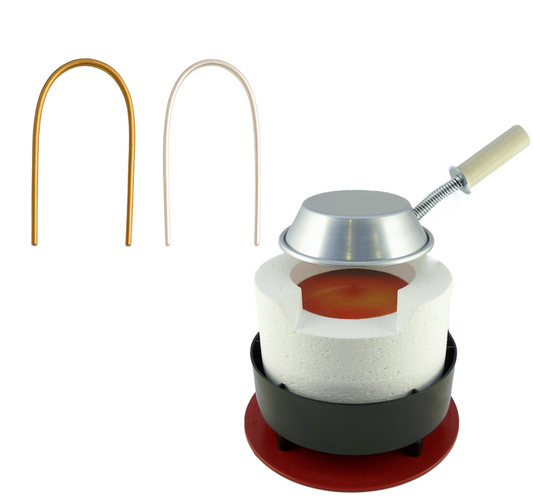
Annealing is a crucial process, especially when working with metal jewelry and cloisonné wires. It is a heat treatment technique used to make the metal more workable, softer, and less...
Annealing is a crucial process, especially when working with metal jewelry and cloisonné wires. It is a heat treatment technique used to make the metal more workable, softer, and less...

In this video, Matt Breunig shares how to repurpose wire scrap and use it as an embellishment for a ring. Learn how to create the band, solder the seam and...
In this video, Matt Breunig shares how to repurpose wire scrap and use it as an embellishment for a ring. Learn how to create the band, solder the seam and...
Overall rating: 4.892857 / 5 from 56 reviews.
Review topics: [instructions, pickle, problem, smell, mix, solution, students, amount, work, silver, service, alternative, heat].
"Easy to use and store. Works like a charm."
— Melissa F. (5/5)
"Amazing silver prep! Love that it cleans all firescale from piece! Great stuff"
— Robin D. (5/5)
"I have not had a chance to try it yet. I love the idea of non - toxic."
— Diane K. (4/5)
"Effective."
— Deitra B. (5/5)
"Good pickle that is not toxic."
— Elizabeth H. (5/5)
"I have been using Silver Prep now for the last 8 months and I really like it. I do traditional metal smithing as well as some metal clay work and it appealed to me be it's not as toxic as other pickles may be!"
— Vicky M. (5/5)
"The instructions were very concise and easy to follow. I was glad that that was sent with the pickle."
— Sandra V. (5/5)
"The pickle was in a powder form and it is non-toxic it has no odor to it and it makes as well very happy to have it"
— Sandra V. (5/5)
"I have been using this pickle for over 5 years now. It's safe for the environment and that's the #1 reason I reorder. It also works perfectly cleaning my silver, brass and copper pieces."
— Deborah T. (5/5)
"I have been using Cool Tools Silver prep for 3 years and love it. It is affordable and effective in soldering in my jewelry making. Only a small amount is used to make up a solution and it?s environmentally safe."
— Svea S. (5/5)
News, Offers, Promotions & More...Sign-up for One or Both!